Showing posts with label EU. Show all posts

Tuesday, 28 June 2016

Jeremy, for the love of the party, please just resign.


Every time I feel like this car crash can’t get any worse, somehow the wreckage of the labour party reverses away from the wall, only to smash full speed back into it. This week has been the most unedifying spectacle and it breaks my heart knowing how hard activists, MPs and the party as a whole have worked these last few weeks. We’ve seen experienced members of the cabinet resign from all wings of the party, from the left wing, such as Lisa Nandy and Kate Green, to Hillary Benn and Charlie Falconer on the right. Sections of the membership continue to attack MPs in the most disgraceful of ways, from vile abuse to the standard “Blairite war mongerer” dig directed at everyone regardless of their views or history. Never mind how did we get here, how do we get out?


Corbyn’s leadership was always going to be rocky, given both his history with the press and how he began his leadership by picking them for his first target. I don’t disagree that they’ve been awful to him, and they have been ridiculous from the start, but it was always going to be that way. To continue picking fight after fight with them was never going to help get his important message across. In the same theme neither were the constant communication own goals we have seen leading to an impression of not just chaos, but sheer incompetence.  Everyone can make a mistake but only a fool repeats the same actions expecting a different outcome. This has to end or the party will disappear and the country will be left dangerously vulnerable to a hard right conservative party unbound by European regulations.

Let me make this clear, I did not vote for Jeremy, but I sympathise with those who did and even more so with those such as Angela Eagle who literally gave it all they had in the hope of making it work. I too wanted to make it work, but seeing her so broken on national television made my heart ache. And this is not the first time she has been treated terribly. Too often we have seen Angela fronting the media when labour is in crisis after crisis, usually not of her own making. Not only this but too often announcements have been made without communication, leaving people like her tirelessly slogging it out in the media only to be undermined live on air about an announcement Corbyns team have made off the cuff, that the shadow cabinet have not been consulted about. It’s not how to manage a team in and it’s not how to run a government. It’s just disrespectful.


There have been some great electoral successes and some of McDonnell’s ideas about private sector right to buy have been just the sort of new thinking we need. The victories of Sadiq Khan, Jim Mcmahon and the metropolitan mayoral contests are great successes we should be proud of. But it isn’t enough. We are not seeing enough signs of labour moving into new seats outside of the big cities. Worse still, we’re seeing UKIP encroach all over our northern heartlands. Not only is UKIP now second in countless northern seats, but they straight beat us in the referendum. As a proud person from Hull this send chills down my spine. If what happened to labour in Scotland happens in these seats then we are toast. The decision to leave the European Union potentially affects these seats most, as I have written about before, and so the decision really is as devastating as I am trying to make out. If this doesn’t worry you, then I fear that you are not really Labour. Labour is not about wearing  a badge of your socialist purity, “old labour” values or whatever other name people are ascribing to, it’s about making an actual difference and doing the best you can for our communities.  


This back and forth war between Jeremy and the press, Jeremy and the right of the party and now Jeremy and all wings on the Parliamentary Labour party has to stop.  New polling has now shown what I feared would happen and a majority of 2015 labour voters now want him to step down. Not only this, but anecdotally even amongst friends who joined the labour party because of him, he is becoming a figure of ridicule. The labour party is not about one person; it’s about a cause and seeking electoral power to fulfil that cause. If the increasing evidence, and there is more than just the recent polling, continues then Jeremy is clearly not the right person. Jeremy is a nice, charming person, but he isn’t cutting through.

I know many have shouted me down when I raise this point. Without question they ask “what is the point in power if you get there with a right wing Blairite agenda?” And I would agree if that were the case that anyone was proposing a right wing agenda, but they’re not. I think that you really don’t know the parliamentary labour party if you’re willing to believe that caricature. When Jo Cox died we all agreed how inspiring her work was. But to believe that she is unique and that no other MPs work as tirelessly for labour values is just obscene. Either you don’t know much about our elected members of parliament or you chose not to because it challenges your views. I have met several Members of Parliament and the people who work for them. They work ridiculous hours, believe passionately in their causes and put up with being treated like punch bags from people on all sides. And they don’t deserve it.


I have my favourites to replace him, but that is for another discussion. What is important is that he and his supporters are given space to consider his position without it being as confrontational as it is now. I am not attacking you because of his or your views, I respect them and largely agree. This is about being able to lead, communicate with the country and run a team and campaign properly. So I ask, please, Jeremy. For the sake of us all. Just go. 

Tuesday, 21 June 2016

Has the EU really done UK fisheries a disservice? Or is it just Farage CODswallop?


Everyone by now I hope has managed to forget the event that was the Brexit Flotilla and erase it from their memory. I expect that most were somewhat moderately to extremely embarrassed, whatever your views, by the prospect of British politics being defined by a pair of rich eccentrics having it out across the Thames. I personally had sympathies both ways, I am voting for remain and so was clearly rolling my eyes when I heard of “our Nige's” latest stunt, however, like most I have sympathy and respect for British fishermen and the difficulties they face. We have all been told how wasteful the common fisheries policy is, how fishing as an industry has been on the decline and how, if we believe our press, foreign ships are taking unfair catches from British waters.

Farage and Hoey camping it up on the Thames

But is this the case? It is a narrative we have all swallowed and a genuine sympathy and respect I expect we all feel for fishermen. Fishermen work incredibly hard in an extremely dangerous job. When they are at sea there time can be sleepless, cold, lonely and away from family and missing out on some of the most formative parts of their children’s lives. Not just this, but we all know of how the industry has changed, as the employment share of fishing has gradually declined. But is the EU to blame?


A look at the decline in employment shows that the number of jobs in fishing had been declining as fishing stocks were also falling, well before the common fisheries policy was implemented. There has been some decline since, but this is not necessarily due to the policy, as other changes have also occurred. As with all industries, overtime productivity increases and the labour intensity also declines.

Landings by profit

The aim of the common fisheries policy is to allow fishing stocks to recover. Over-fishing, particularly in the North Sea, has led to a decline in many of the most popular stocks of fish. This is a big problem, acknowledged by most fishermen at the time of the creation of the common fisheries policy. If this had been allowed to continue, it would have led to greater declines of the fishing industry, across all countries using the North Sea, than we have actually seen. Since then many stocks have recovered and quotas, including Britain's, have began to be increased. In addition the practice of dumping when vessels over fish has been reformed.

Landings by value and weight

Another important point on this topic, which surprised me, is the advantageous position UK fisheries get vis a vis our neighbours. The quota system was set in relation to the level of national catch taken in the 1970s in order to preserve fishing communities at their then levels. Within this, the UK has the second highest catch of all countries. In addition the UK has the largest profit on its sales of any country and is in the top three for the weight and value of its catch. 

Many people are angry about foreign fishing vessels active in British waters, but it is worth considering what action could realistically be taken here. The UK as mentioned gets larger quotas then other countries and also fishes in many other countries waters, as well as selling in their harbours and receiving repairs there. So any ban on other countries could have detrimental consequences for UK fisheries.


Tonnes of allowed fish by EU member states 2016

Of the UK fishing catch £1 billion is exported to other EU countries, particularly Spain and Southern Europe, which lack many of the cold water fish stocks located in our waters. David Cameron has pointed out that no country in the world exports fish into the EU market tariff free, including Norway and Iceland the big bogeymen of British fishing, and so British fishing could be massively hit in the event of a Brexit. 

The biggest irony appears to be, particularly for smaller fishing vessels,  that it is the UK government which has done the biggest damage to British fishing. A look at the level of quotas given out within the UK shows that the government has continuously given the majority of it's fishing quotas to just 3 companies, with massive effects on the smaller vessels and smaller fishing towns. It is the British governments responsibility, and always has been, to decide how it allocates its quota. It was the British law which allowed the infamous dutch ship the cornelis vrolijk part of the British quota and again, a British government which gave over 60% of the quota to just 3 companies, leaving just 39% for everyone else.....

There clearly are other issues which I am unaware of and would not want to comment on around health and safety and other regulations in the fishing industry. I also think until it was reformed the practice of dumping was still a massive issue, but has since been looked at and has improved. My point being that there are clearly other big issues. 

The position of British fishermen in the EU is therefore not as simple as the CODswallop Farage has been spinning. Contrary to what he has been saying about the EU quota system, designed to ensure larger stocks in the future, the UK has a better position then it's competitors; it has larger quotas, catches and profits then other countries. The problem appears to be that the UK government has showed constant and blatant disregard for the industry. They have ignored smaller British vessels and favoured big businesses .Not only this, but the very scare stories blamed on the fisheries policy are  actually the UK's fault. It was British law which allowed the infamous dutch vessel to take so much of the British quota and not the common fisheries policy.


Please see below for further reading and refferences on data etc


Sunday, 19 June 2016

How would Brexit affect British manufacturing and is Hull most at risk?


The majority of Brexit campaigners have accepted that their will at least be an immediate short-medium term hit to economic growth in the event of a leave vote occurring next Thursday. This is the result of the uncertainty such an event will likely cause, with the potential job losses and turmoil being described in the Sunday times as "difficulties". Indeed such “difficulties” have already began to show themselves with over £100 billion disappearing from UK stock markets in the last 10 days alone affecting both levels of investment and the very assets our pension funds depend on. But what would this mean for the future of the economy in terms of what we make, produce and sell to the world and, in particular, what would it mean for Hull?

In a recent interview a prominent Brexit campaigner admitted when discussing the likely changes to the UK economy which will occur following a vote to leave that, whilst he thought the economy would thrive eventually, it would largely mean an end to manufacturing production within the UK. This candid and rather stark omission seems more befitting of a pre-financial crisis analysis of the UK’s economic future with the then typical adulation of the financial services sector.  It is really quite striking how far debates have come since 2007 that it seems, at least to me, so jarring with current political consensus on the future of the economy and the re-balancing agenda. This can be seen, even as presented by a conservative chancellor George Osborne, on the need for the UK to re-balance and the talk of the Northern Power house.

That said, whilst it may seem at odds with much political discourse on the economy, it does contain a large element of truth on what would likely occur in the event of a Brexit to UK manufacturing. In the event of a Brexit there are at least 4 major risks to UK manufacturing;

1) Any increases in tariffs will make already expensive UK exports even less competitive

2) Any trade deals with big blocks like China, the EU or USA will likely favour their terms and, in the case of China, almost certainly mean the UK economy opening up earlier to free trade than in China, with terrible consequences for UK companies. 

 3) A loss of investment as EU institutions, which have favoured industrial regions in the UK, such as Hull, plus a further loss as companies looking for an EU base for their production look to EU locations rather then an isolated UK ( e.g Hitatchi, Toyota). 

4) If the UK does move more to financial services, as would likely be the case, it will lead to massive strengthening of the pound due to the inward flows of capital and a further increase in the price of UK exports making them less competitive.


But why does this matter if, as many people believe, “we don’t produce anything anymore” . The problem is that this often spun misconception simply is not true, industrial production has never actually declined in the UK and the country remains one of the largest exporters of manufactured goods in the world. The only change which has occurred is the total share of employment within industry which has declined, as productivity has increased with new technologies and innovations. Indeed even in spite of this change in productivity many northern industrial belts cities still contain some of the largest industrial shares of employment, ranging up to nearly 20% employed directly within manufacturing. This is then supported by many more employed in ancillary services supporting those industrial companies. 


This is unquestionably true of my home city of Hull. As can be seen from the industrial employment share map of the UK above, Hull's share of employment in manufacturing is one of the highest in the UK. Not only this, but it is also one of the most industrially diverse manufacturing cities which has not fallen into  the regular trap of specialising in one particular type of production like steel making. Many big household names have large production sites in Hull and East Yorkshire, including Reckitt Benkisser one of the worlds largest pharmaceutical companies which started in Hull, employs 1200 people and is investing over £100 million in the city. As well as this, Hull's thriving caravan and temporary building construction industry is one of the biggest in the UK and relies on exporting to the continent. The sector employs nearly three times as many people in Hull, as proportionally in the country as a whole. Other big companies with big shares of employment and production in Hull include BP, Smith and Nephew, Henner, Cranswick Foods, Arco and now the massive Siemens renewable energy investment in Hull creating 1000 jobs and representing a £160 million investment. 

The proposed Green Dock and Turbine proposed by Siemens representing 1000 jobs
In addition the largest share of Hull exports goes to the European union and would be at risk both from increased tariffs in any form, but also from the disappearance of European direct investment in the UK. This includes investment from companies looking for a European Union base for their production, but also the direct funding from European economic institutions which have favoured the region.


Hull has the second highest level of investment per head of all English regions by European economic institutions, such as the European investment bank. I accept the argument that this is UK money going via the EU, but does anyone in Hull really believe that a likely Boris Johnson led Conservative, or even Labour government would prioritise the region? They have never done so before and even the "Northern Power House" agenda has largely ignored the city. None of the big transport projects will be coming to the region and so the argument that a UK government would maintain the investment or, even increase it to Hull, is at best frankly farcical and at worst down right insulting.

There are also massive none economic projects in Hull which have relied on European Union investment. The deep received £9.4 million of European Regional Development Funding, the Kingswood development was funded by the same scheme, Hull and East Riding museums have received over £1 million in funding, the Hull truck theatre received £1.5 million towards it's development, £25 million is being invested in Hedon Parklands to turn it into a business centre, the Gypsyville transformation too, Ferensway and also Bridlington Spa have benefited. Many of these within the Arts and Culture sector have become reliant on European funding at a time when the UK culture budget has been decimated by an austerity focused conservative government. 


A look at the employment shares within Hull below shows just how dependent Hull is on manufacturing compared to the rest of the UK. A number of 1.0 means that the employment within that sector in Hull is proportionally the same as across the country. Any number above represents a higher share of employment in Hull then across the country as a whole, with vice versa any number below less. For example the share of manufacturing employment in Hull is 1.8 compared to the UK as a whole, meaning manufacturing makes up proportionally nearly twice as much of Hull's employment as the national average. This could potentially mean dire economic consequences for Hull should manufacturing indeed be hit in the event of a Brexit.

Source:Office For National Statistics


There are clearly many other arguments to leave which I have not touched upon here, the point of this is to show just how vulnerable Hull is to a Brexit, if as is likely manufacturing were to be hit. Hull is a proud trading city which, increasingly rarely for the UK, has a very diverse industrial sector which it should be incredibly proud of. Hull exports all over the world and indeed massively to the European Union. An outward looking Britain being an active part of a dynamic European Union makes Hull stronger not weaker. This international focus has been and continues to be the key to some of our biggest success stories. In the event of a Brexit manufacturing will be massively at risk and the economic future Hull has been working for and deserves will  be needlessly put in jeopardy.  The rules of the European Union mean regions like ours who have been hit hardest by the recession and changes in the global economy are prioritised for funding. Does anyone honestly believe that this funding would be given back to us in the event of a Brexit by the very domestic institutions and politicians that have ignored us for so long? I doubt it. When you hear those promises from the likes of Boris Johnson, Michael Gove and Nigel Farage, remember the past. They have never delivered for us before so we would be a fool to believe them now.....


Wednesday, 8 June 2016

Trade Deals: Does Europe really need the UK more than the UK needs Europe?


At this point in the referendum the proliferation of various claims from each side can become daunting with the sheer volume meaning little scrutiny or perspective can actually be given to both their truth and also the bigger picture. One such claim is with regards to the economy and the economic impact on our prospects and also investment in our country in the event of a Brexit. 

The central claim of the leave campaign is that any post Brexit trade deal would not be difficult to organise as the incentives to trade will not vanish, which is true.  Additionally as the 5th largest economy in the world Britain is an important market, also true. Moreover a Brexit would free Britain to create new trade deals with the US and China, also true

So far so good I hear you say, however this is where the argument becomes unstuck. As Farage claimed in yesterdays ITV debate, Europe needs us more the we need Europe and it is businesses that organise trade not governments.....NOT TRUE. 

The incentives to trade would not dissipate but one of the central tenets of the trading game is that the terms of trade matter, just ask any developing country or even Japan and the USA trying to trade with Europe. There is massive pressure to protect your strategic industries and institutions which are important to electorates; just look at the furor over TTIP and TPP and you can see how difficult these are to settle. With this in mind you can understand why countries would fight tooth and nail to set the terms of trade, including tarrifs and rules of production in their favour.

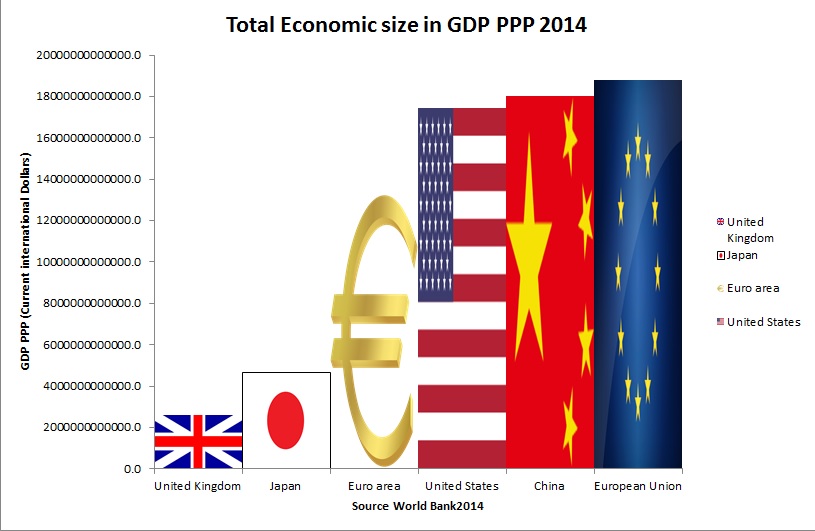
This brings us to the position of the UK in establishing trade deals with both Europe and other large countries and blocks such as China, the USA and ASEAN. What can be seen from the image above is that by GDP PPP (which takes account of currency movements and different prices) the UK is a significantly smaller market then those with which it would seek to establish an advantageous trade deal. It is true that the UK is the 5th largest economy by nominal GDP, but this is not the best measure. By GDP PPP the UK is actually 9th and growing slower then many developing countries. In addition, the UKs' key industries services and financial services have major competition in each of the big blocks it would seek to create a trade deal with; Frankfurt in Europe, Wall Street New York in USA and Hong Kong in China. What this means in the cold hard world of trade deals is that each would seek to set the terms of trade which would help them steal business from the UK. To expect anything else would be naive. 

What Europe gives the UK is the power to set terms of trade in our favour and to protect our key industries in a way our economic size alone would not. This is not to talk down the UK, but to set out in a clear and realistic way the options we face and the advantages remaining in the European Union give us in negotiating terms of trade which would protect our jobs and allow us to grow more quickly. This applies not just to economics but politics, the power to influence other countries by harnessing Europes collective economic heft magnifies British power, it does not diminish it.